
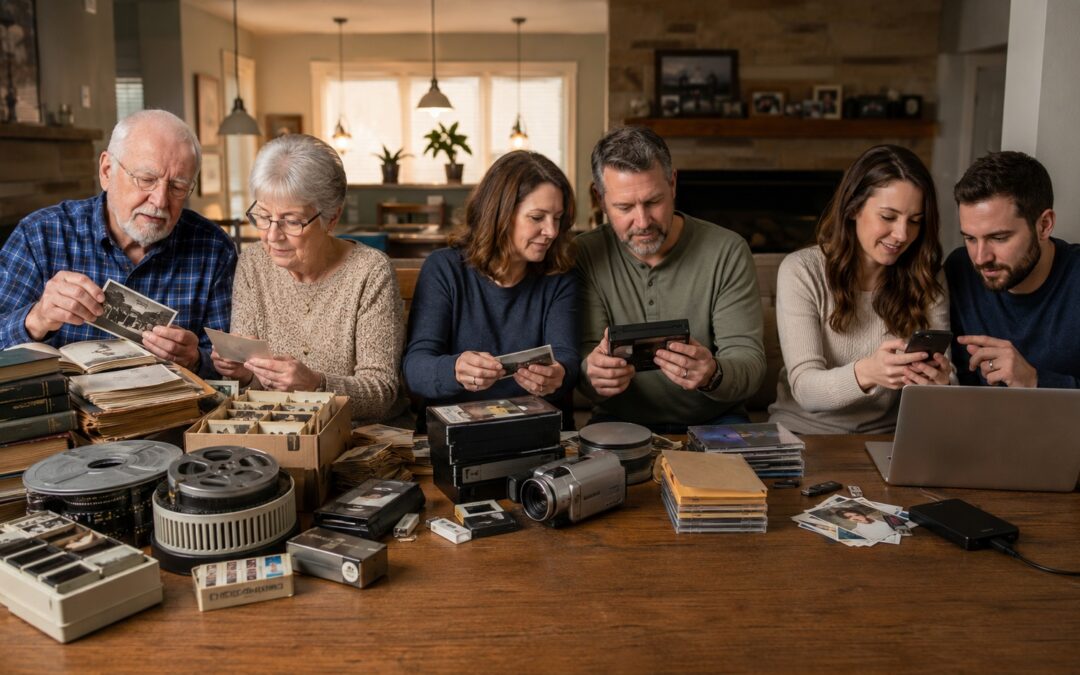
Every family has a memory collection somewhere. It might be a box of slides in the closet, VHS tapes in the garage, photo albums on a bookshelf, or thousands of pictures sitting on a phone. Some memories are printed. Some are recorded on tape. Some are stored in cloud accounts that no one has organized.
So, which generation has the most family media to preserve? The answer is not as simple as one age group having “more.” Baby Boomers, Gen X, and Millennials each hold a different kind of family archive. The real question is what kind of media they have, how fragile it is, and how easy it will be to access in the future.
Why Family Media Looks Different by Generation
Family media follows the technology of its time. The way people have recorded birthdays, holidays, weddings, graduations, and everyday moments has changed dramatically over the last several decades.
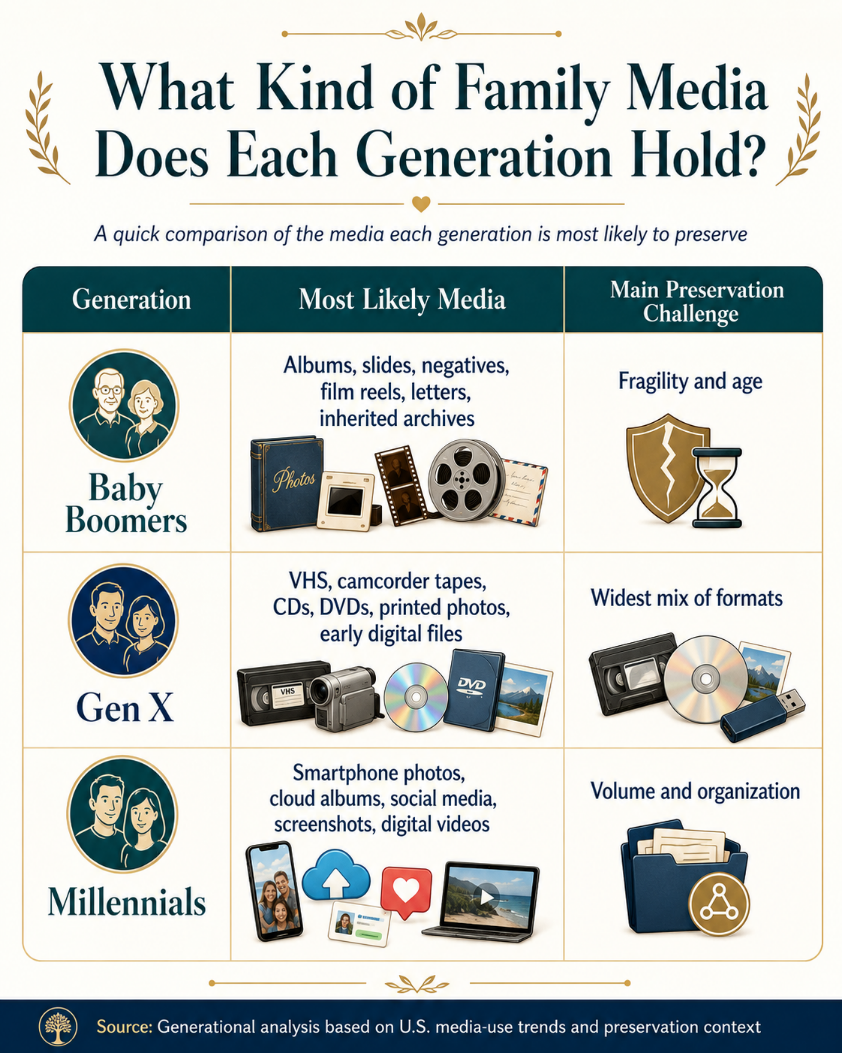
Baby Boomers are more likely to hold older physical media, including photo albums, slides, negatives, film reels, letters, and family documents. Gen X grew up during the rise of home video, which means many families in this generation have VHS tapes, camcorder tapes, CDs, DVDs, printed photos, and early digital files. Millennials are more likely to have digital-first collections, including smartphone photos, social media albums, cloud libraries, screenshots, and digital videos.
Pew Research Center defines Millennials as people born from 1981 to 1996, Gen X as those born from 1965 to 1980, and Baby Boomers as those born from 1946 to 1964. Those generational lines help explain why each group tends to preserve memories in different formats.
Baby Boomers: The Keepers of Older Physical Archives
Baby Boomers may not have the largest number of individual files, but they are often the keepers of the oldest and most fragile family media. Their collections may include their own childhood photos, their children’s early years, and inherited materials from parents or grandparents.
That makes Boomer collections especially meaningful. A single box might hold decades of family history, including printed portraits, slides, 8mm or Super 8 film, letters, certificates, newspaper clippings, and early home videos.
Boomers also remain a large and influential part of the U.S. population. According to Pew Research Center’s analysis of U.S. Census Bureau data, Baby Boomers numbered 71.6 million in 2019, compared with 72.1 million Millennials and 65.2 million Gen Xers. That means millions of families may still have Boomer-held archives sitting in closets, basements, storage rooms, and family homes.
For Baby Boomers, the preservation challenge is often age and fragility. Photos fade. Slides collect dust. Film becomes harder to play. Paper records can become brittle. The memories are still there, but the formats may be getting harder to protect.
Gen X: The Bridge Generation with the Widest Format Mix
Gen X may have the most complicated preservation job of all. This generation sits between the analog and digital worlds, which means their family media often exists in many different formats.
A Gen X household might include childhood prints from the 1970s and 1980s, VHS tapes from the 1990s, Hi8 or Digital8 camcorder tapes from family vacations, CDs of early digital photos, DVDs from school events, old USB drives, external hard drives, and smartphone pictures from their own parenting years.
This makes Gen X the “bridge generation” of family media. Many are old enough to have inherited analog media from parents, but also young enough to have created large digital collections themselves.
Gen X also came of age during the home video era, when camcorders and VHS tapes became part of everyday family life. In U.S. pop culture, shows like America’s Funniest Home Videos reflected that shift by turning ordinary home video clips into mainstream entertainment. For many families, the tapes stored in a cabinet today come from that same era of birthdays, backyard games, school performances, and living-room moments caught on tape.
For Gen X, the challenge is not just preserving one format. It is finding, sorting, and converting a mixed archive before playback equipment becomes harder to access.
Millennials: The Generation with the Most Digital Clutter
Millennials may have fewer film reels and VHS boxes, but they may have the largest volume of family media overall. Their memories are often digital, constant, and scattered across many places.
A Millennial family archive may include smartphone camera rolls, social media posts, shared albums, cloud storage, messaging app photos, screenshots, downloaded videos, old laptops, external drives, and forgotten phones. The problem is not always deterioration. It is volume, duplication, and disorganization.
U.S. digital habits show how quickly this shift has happened. Pew Research Center reports that 98% of U.S. adults now own a cellphone of some kind, while 91% own a smartphone. Smartphone ownership has grown sharply since Pew’s first smartphone ownership survey in 2011, when only 35% of U.S. adults owned one.
That shift has changed the way family memories are made. Millennials may have thousands of photos from one child’s early years, but those memories may be spread across phones, cloud accounts, apps, hard drives, and social media platforms. The memories are easy to create, but harder to organize into something lasting.
So, Who Has the Most Family Media to Preserve?
The clearest answer is that each generation holds the “most” in a different way.
Baby Boomers may have the most historically valuable physical media. Gen X may have the widest variety of formats. Millennials may have the highest volume of digital photos and videos.
That means the preservation priorities also differ:
- Baby Boomers may need to protect fragile albums, slides, films, and inherited family records.
- Gen X may need to convert mixed media collections, especially VHS, camcorder tapes, CDs, DVDs, and early digital files.
- Millennials may need to organize and back up digital memories before accounts, devices, and cloud access become confusing or inaccessible.
The most urgent need, however, often belongs to analog media. The Library of Congress notes that audiovisual materials, including magnetic tape and optical discs, can have chemical instabilities and require careful storage, handling, and clean playback equipment.
Why Analog Media Often Needs Attention First
Digital clutter can be overwhelming, but analog media often has a narrower preservation window. A phone photo can usually be copied, backed up, or moved to another device. A VHS tape, camcorder cassette, or film reel needs the right equipment and careful handling before it can be watched again.
The National Archives also notes that magnetic-based audio and video media may be among the least stable archival formats, depending on the age, tape type, and storage conditions. It also points out that proper playback equipment must be available, which is one reason significant tapes are often copied or reformatted.
Digitization does more than make media easier to watch. The National Archives’ digital preservation guidance emphasizes ongoing planning around data integrity, format sustainability, media sustainability, and access. The same idea applies at home: once a memory is safely digitized, it becomes easier to share, back up, and protect.
Families with older tapes can explore Leave A Legacy’s video transfer services in Fort Collins and Denver to convert fragile home movies into digital files that are easier to preserve and enjoy.
What Families Should Preserve First
If your family has media from more than one generation, start with the items that are hardest to replace and hardest to play.
A practical priority list may look like this:
- VHS, camcorder tapes, 8mm tapes, and other formats that require older playback equipment
- Film reels, slides, and negatives that may be fragile or fading
- Audio recordings of relatives’ voices
- Printed albums, loose photos, and family documents
- CDs, DVDs, hard drives, and USBs with unknown contents
- Old phones, laptops, cloud accounts, and shared digital albums
Families with 8mm, Video8, Hi8, or Digital8 tapes can also use Leave A Legacy’s 8mm video transfer service to bring older camcorder footage into a more accessible format.
The Real Winner Is the Family That Preserves Early
This is not really a competition between generations. Baby Boomers may hold the oldest physical archives. Gen X may hold the widest mix of formats. Millennials may hold the largest digital libraries. But the most important family media is the media that can still be found, opened, watched, heard, shared, and passed forward.
Every generation has memories worth protecting. The sooner families begin sorting, digitizing, and organizing them, the easier it becomes to keep those stories alive.
To preserve your family photos, videos, film, audio, and other treasured media, contact us and let our team help you to turn fragile formats into memories your family can revisit for generations.
Sources
https://www.pewresearch.org/internet/fact-sheet/mobile/
https://www.archives.gov/preservation/holdings-maintenance/machine-readable